Is RFK Junior Radical?
#82


The USA just announced an update to the recommended food policy to Make America Health Again. There is a line of media commentary that assumes that the Health and Human Services Secretary, RFK Junior is promoting policies that go against scientific evidence and the norms that other governments follow.
Is the USA new policy really that different to other nations that justifies such a media reaction?
Does a public health policy really make a difference to a citizens nutrition habits?
The battle with obesity drives policy
There have been government nutrition policies for a long time. The USA published it’s first one in 1897 about the same time as the UK. Denmark started 50 years ago and France 20 years ago.
I’m going to use these four nations as benchmarks to answer the question is the new USA policy really that different to other nations.
There has been two phases of nutrition policy in the USA.
Undernutrition Era (1900–1950): Focused on reducing deaths from starvation and deficiency diseases like rickets (via fortified milk) and pellagra (via fortified flour).
Overnutrition Era (1950s–Present): Shifted towards combating chronic diseases, focusing on reducing saturated fat, sugar, and salt intake.
This shift was caused by the success of the USA and to a lesser degree, the UK in massively increasing the productivity of food production and creating low cost food that made over eating affordable and easy. This caused a rise in obesity which is one of the biggest causes of chronic health conditions and lower life expectancy.
The problem is acute. The World Obesity Federation ranks nations in terms of percentage of obese people in the population.
Adults - USA 19th, UK 77th, Denmark 150th, France 172nd. 43% of the USA population are classed as obese compared to 10% in France.
Children - USA 22nd, UK 86th, Denmark 146th, France 170th. 20% of USA children are obese compared to 4% in France.
It is really clear that there is a huge public health problem in the USA with obesity so government should intervene to do something about it.
It’s also interesting that the nations with the biggest obesity issues have had government policy on nutrition the longest and the nation with the shortest intervention period, France has the lowest.
That is because France has a lot of regulation on food quality, a very positive food culture in terms of what and how things are eaten and a healthy disregard for mass produced, convenience food.
I love going to France and Italy as they always make time for a sit down lunch. They see food as a pleasure that time should be dedicated to rather than convenience to be eaten quickly. Most workplaces have staff restaurants and if not it is normal for everyone to go out to a restaurant or café at lunch time for a meal.
In Denmark as example, a client of mine was a private trading bank. They had a staff restaurant that had food designed for high performance by sports nutritionists so the traders could stay at their peak throughout the day. They understand quality food matters.
In contrast the USA has the highest density of fast food outlets. There is one fast food site of the major fast food brands for every 4,610 people in the USA. That compares to 11,000 people in the UK, 21,000 people in France and 40,000 in Denmark.
Fast food culture dominates in the USA.
Food culture will always beat food policy.
Is the new USA policy really that different?
I reviewed all the policies so you don’t have to.
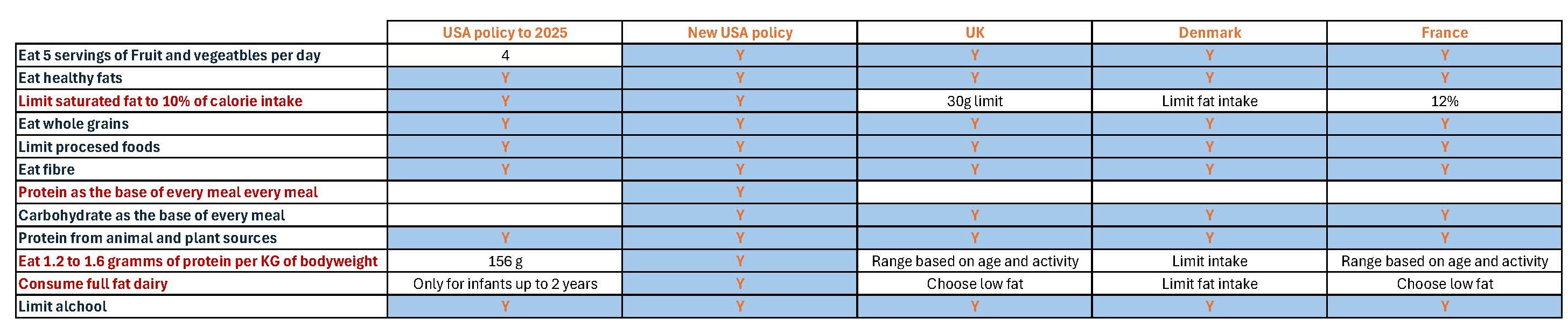
There are 4 differences highlighted in red
The USA policy has the lowest saturated fat goal. Which is a positive.
The new USA policy is the only one that makes protein the base of every meal.
The new USA protein goal is one range for everybody while the UK and France set lower ranges for healthy adults, 1g per KG bodyweight for older people and 1.2 to 2g range is only for very active adults doing strength related activity.
The new USA policy is the only one advocating full fat dairy.
The difference in the policy is Protein
Is it really that different to other nations?
The base target is probably a tiny bit higher than the 0.8 to 1g per KG bodyweight that other nations recommend. The new recommendation of 1.2-1.6g is only required if you are doing intense resistance training to build and preserve muscle. Otherwise it becomes an expensive energy source
More protein is required when you get older as you don’t process it as well but eating 1.6g per KG of bodyweight is difficult for older adults with low appetites.
Although the new USA policy advocates higher protein it still suggests a mix of protein sources and has the most stringent limit on saturated fat. This means it’s advocating leaner protein options. Which is the same as other nations.
So it’s only slightly different and well within the norms determined by nutrition research.
Is the media noise justified?
No it isn’t that much different, except the protein at every meal and full fat dairy recommendation.
The previous USA policy recommended a total daily protein amount which was low compared to the average weight of USA adults so the protein policy is getting more in line with other nations policies.
There is nothing radical about this policy. With a 43% adult obesity rate in the USA it’s not being followed anyway.
The reality is given the high density of fast food outlets and overeating culture in the USA the new policy will not impact the obesity issue. As the French prove good food culture beats guidelines and policies.
To be really radical RFK Junior would regulate against the USA over eating, fast food culture. But the USA President lives on fast food so we shouldn’t expect anyone in this administration to do that. This new policy is the least radical action that could have been taken.